Annual Exhibition 2026
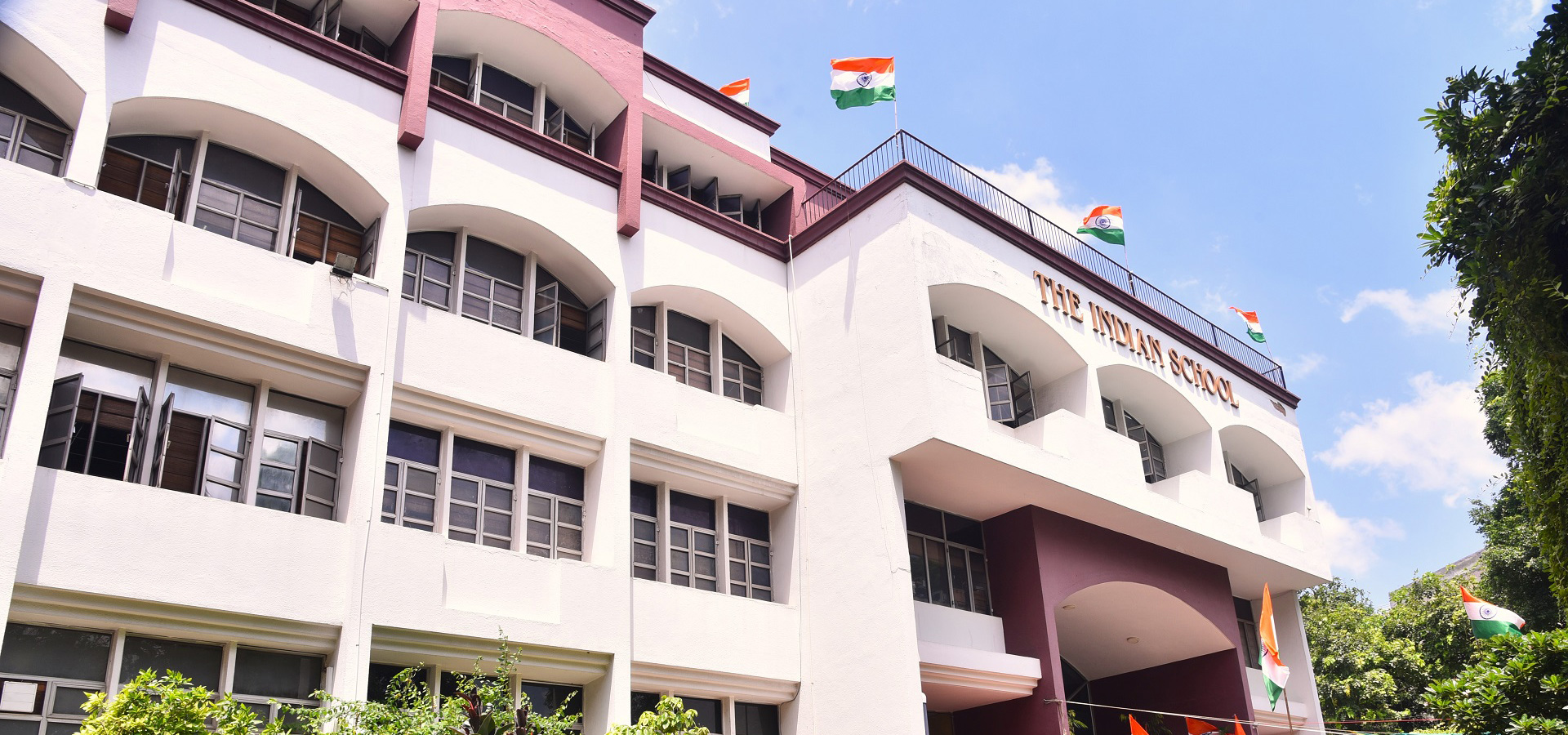
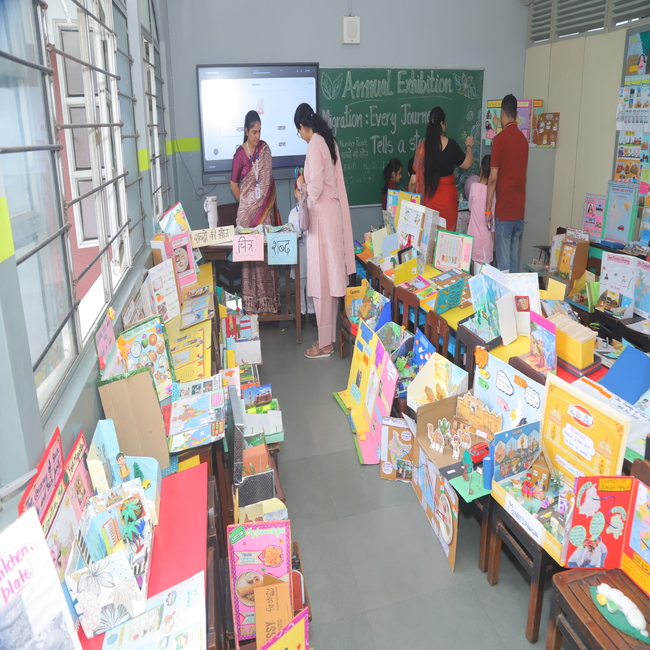
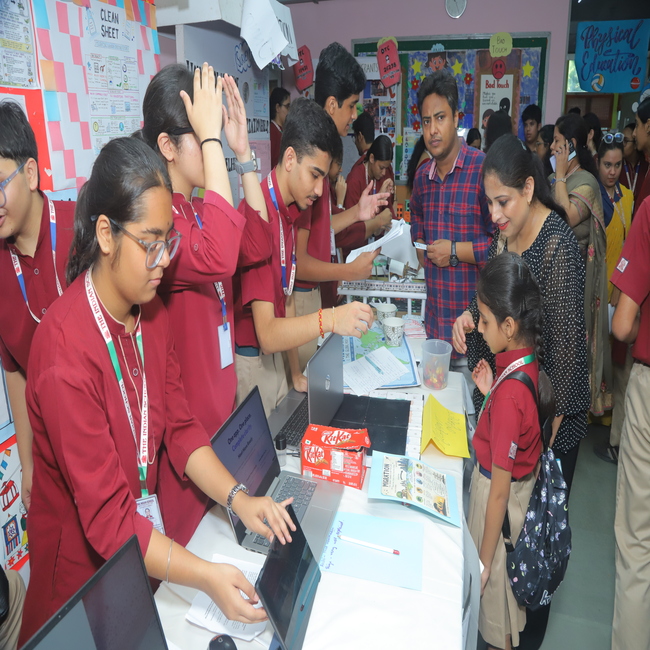
The Annual Exhibition 2026–27 at The Indian School was a splendid celebration of imagination, intellect, and inquiry. Held on 22 August 2026, the event brought together the boundless creativity and curiosity of students from across all classes under the overarching theme of “Migration”, harmonised with the forward-looking paradigm of “Momentum: Shaping Technology”. The campus was transformed into an interactive hub of experiential learning, illuminating the journeys of people, ideas, biodiversity, culture, and technological innovation across time and space.
The day commenced on an inspiring note in the auditorium with the inaugural assembly, opened by the School choir’s soulful motivational songs and a vibrant instrumental fusion presented by the orchestra, comprising students of Classes V to XI.
Upholding the School’s cherished tradition of gender parity and mutual respect, the assembly featured students tying rakhis to one another, boys to girls and girls to boys, symbolising equality and shared responsibility. The youngest learners of Classes I and II won hearts with their stirring renditions of Vande Mataram, Saare Jahan Se Achha, and Chhodo Kal Ki Baatein. Principal Ms Tania Joshi then warmly addressed the gathering, commending the students and educators for their multidisciplinary vision and emphasising the vital importance of experiential learning in bridging classroom theory with real-world phenomena.
Marking an academic highlight of the morning, the 14th edition of the School science magazine, Science Musings by an Indianite 2026–27, was officially released, following which the Annual Exhibition was formally declared open. The energy then spilt outdoors as a spirited flash mob near the skating rink added a lively, spontaneous pulse to the inaugural atmosphere, setting an enthusiastic tone for the events ahead.
The occasion was graced by Dr (Ms) Nayana Goradia, Vice Chairperson, Ms Brinda Goradia Shroff, Director, and Ms Madhavi Goradia Divan, former Additional Solicitor General of India and esteemed member of the School Managing Committee, who toured the exhibits, engaged with the young innovators, and expressed their immense delight and appreciation for the students' ingenuity and creative enterprise.
The Science Department presented an exhaustive display of scientific inquiry, sustainable engineering, and cutting-edge design across all levels. In the Primary Wing, Class III explored domestic science and foundational Physics through exhibits such as Layer Up! Insulation Challenge, From Curd to Butter, Balloon-Powered Toy Car, and a comparative counter on traditional oral hygiene. Class IV examined optics and atmospheric pressure with their Mystery Beam Detector, Hidden Straw Mystery, and an Invisible Wind Tunnel, explaining light refraction and the Tyndall effect alongside leaf venation in Nature’s Hidden Patterns. Class V bridged environmental chemistry and biology through working models of the heart and lungs, Electrolysis of Water, Recycled Catapult Basketball, Self-Inflating Balloon, Natural Acid–Base Indicators, and demonstrations exploring acoustic vibrations and light diffusion.
In the Middle School, Class VI tackled Mechanical Physics and environmental engineering with working models of a Hydraulic Lift demonstrating Pascal’s Law, an Earthquake Detector Alarm, a Maglev Train, an Arduino-Based Sensor Car Parking System, open circuits, motion sensors, electromagnets, and an integrated prototype for waste management on agricultural farms. Classes VII and VIII showcased an advanced integration of the sciences. Their Physics displays featured a Solar Tracker, Alcohol Detector, Hydraulic Press, F1 Car, and an Earthquake Sensor. Chemistry came alive through chemical kinetics and green solutions, including the Blue Bottle Experiment, Chameleon Experiment, Pyrolysis of Water, Hydrogen Fuel Cell Technology, Voltaic Cells, and Plas-Stick for microplastic removal. Biology displays investigated living systems with high precision, featuring a Mini Ecosystem in a Jar, Woodpecker Adaptation, disease transmission mechanisms, food preservation methodologies, and live agar cultures illustrating bacterial growth and antibiotic resistance, complemented by interactive cell-biology board games.
The Senior School merged applied science with artificial intelligence, assistive mechanics, and computational research. In Physics, healthcare technology was represented by GRIP X, which used flex sensors to convert sign-language gestures into readable text; Posture Vision, which deployed sensors and Python to monitor spinal alignment; and diagnostic algorithms like Anaemia AI and Rehab AI Lite. Phyllax demonstrated satellite-guided navigation for deaf-blind individuals, while Root Sense and Eco Grow addressed agriculture. In security systems, the Wi-Fi Motion Detector demonstrated human motion sensing through electromagnetic-wave distortion, alongside a Laser Security Alarm, a Piezoelectric Bridge, an Anti-Sleep Alarm, and demonstrations of Ferro Cells, Centre of Mass, and adaptive colour camouflage. The Chemistry pavilion explored solutions for industrial waste valorisation, green materials synthesis, and electrochemistry, while Biology integrated modern biotechnology through models of cell migration, neural coordination, plant disease detection via Computer Vision, bioinformatics modelling of haemoglobin mutations, an interactive Healthopoly game, a carbon footprint calculator, and a virtual reality anatomy module.
The Mathematics Exhibition explored the theme of “Migration” by showing how numerical analysis, geometry, and spatial modelling reveal movement and human settlement. The youngest mathematicians engaged parents through hands-on arithmetic challenges including Number Puzzles, Number Flowers, Number Tower Pyramids, Multiplication Wheels, and Division Treasure Island. Classes VI to VIII presented MATHEMAGIC, mapping coordinate geometry across physical transit routes, alongside visualisations of algebra, magic squares, 3D optical illusions, the Golden Ratio, and Virahanka Numbers. In Classes IX and X, students applied coordinate geometry, trigonometry, heights and distances, and statistics to real-world migration logistics, such as transit-route mapping, travel budgeting, and affordable housing planning. Senior students in
Classes XI and XII demonstrated advanced computational and quantitative modelling. Their Financial Corner introduced visitors to equity market trends and investment planning via a bespoke Financial Calculator, while a custom Seating Arrangement Application solved permutations and combinations under real-world constraints. The Population Growth and Epidemic Model illustrated epidemiological spread across shifting demographics, and the gamified Math Dungeon challenged visitors with algorithmic puzzles.
The Social Science and Humanities Department conceived an expansive display across two distinct sections, examining migration as a transformative historical, sociological, and economic process. Section I, spanning Classes VI to X, opened with an evocative installation of a half-globe without political boundaries, tracing the global flow of indentured labour, colonial goods, and diaspora networks. Class VI focused on the natural world through bird migration simulators and seasonal route maps, whilst Class VII presented Art and Architecture, exploring how Persian and Central Asian craftsmanship influenced Mughal monuments through detailed replicas of the Taj Mahal and Humayun’s Tomb. Class VIII presented From Threads to Tales, chronicling the migration of cotton, silk, denim, and the saree. Class IX traced maritime history in Timeline Ship Collection, juxtaposing colonial sea routes with contemporary disaster- and conflict-induced migrations, including the Russia–Ukraine war. Class X mapped international migration theory, illustrating the Lewis Model, the Todaro Model of Migration, and the modern implications of Brain Drain and Brain Gain.
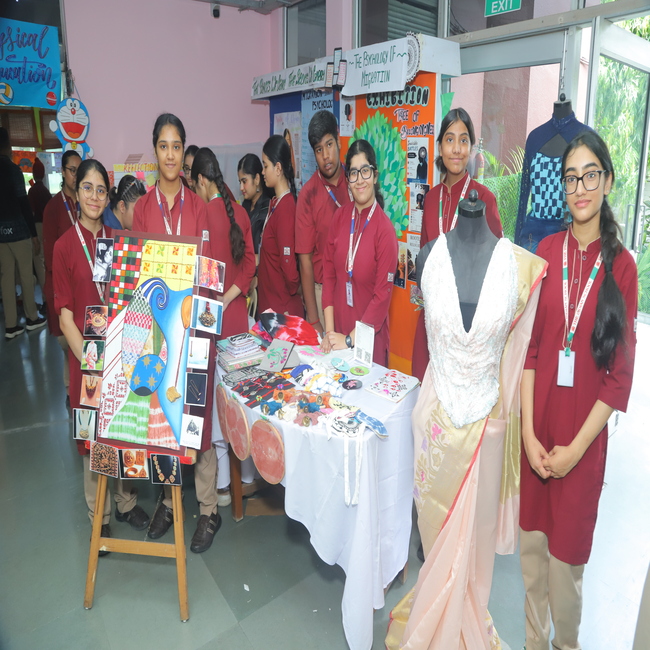
In Section II, under the banner “Delhi – A Hub of Migration”, senior Humanities and Commerce students explored how waves of resettlement built the capital. Welcoming visitors through arches evoking Purana Qila and Humayun’s Tomb, the History wing featured layered acrylic maps tracing the evolution of refugee colonies like Lajpat Nagar and Karol Bagh, alongside a Migrant Trunk installation containing historical artefacts and an app prototype named Aspire for migrant skill documentation. The Fashion Studies wing displayed fusion garments, including a corset-saree, and student-crafted artisanal textiles. The Psychology section examined emotional dislocation through The Tree of Belonging and the “What Would You Pack?” suitcase activity, while Sociology documented oral histories of domestic and transport workers. Economics students surveyed Delhi's infrastructure and the transit revolution from the railways to the metro. Complementing the academic displays, Commerce students celebrated their entrepreneurial acumen after a double win at the inter-school conclave #tagGED 6.0, securing Second Position in both Off the Record and Pivot Point.
In the cultural domain, Classes VI and VII curated exhibits on Disappearing Occupations of India and Vocal for Local, showcasing traditional pottery and woven crafts, while Class VIII reconstructed an authentic Irani Café tableau exploring how migration enriched India's culinary landscape.
The Computer Science arena showcased projects ranging from foundational coding to artificial intelligence and accessibility engineering. Primary students personified modern conversational tools, dressing up as the Google Gemini and ChatGPT applications, while Classes V and VI created interactive Scratch games on butterfly migration and game design. Classes VII and VIII demonstrated sophisticated hardware-software interfacing, developing an interactive HTML web application, an ultrasonic Arduino Radar for spatial obstacle detection, and Migvance, a platform offering digital identity solutions for migrant workers. Class X presented Neon Exodus, an interactive digital game, alongside an algorithmic resource-allocation portal to optimise state budgets. Senior students exhibited high-calibre systems, including CityOS, an AI-powered smart city operating system integrating GIS spatial data; NeuroFront, an interactive cardiovascular simulation; Gyaan Setu, an AI platform bridging educational disparities between rural and urban schools; and Gayatri, a linguistic translation algorithm converting Sanskrit shlokas into modern vernacular languages, alongside an automated Doubt Solver and a comparative pathfinding algorithm visualisation. Class XII students documented the entire tech exhibition in a creative short film that captured the planning and energy behind the exhibits.
The Hindi Department captured the linguistic, literary, and historical dimensions of migration across all grades. Class I engaged visitors with the Picture to Word vocabulary initiative and a digital interactive module titled Matra Masti. Class II staged an energetic street play titled The Journey of Spices, accompanied by a digital Hindi Riddle Challenge. Class III presented Migration of Food, exploring how foreign ingredients like potatoes, chillies, and tomatoes integrated into Indian cuisine, complete with culinary tastings. Class IV presented The Moving World: Stories of Migration, featuring a masked Dhamaal folk dance, an informative presentation on Girmitiya labourers, and interactive language games like Varg Paheli and Hindi Sudoku. Class V presented games on antonyms and synonyms, an illustrated model tracing the courses of Indian rivers, and a working model of the Gaganyaan mission. Middle school students presented creative portfolios such as Yatra Vivranika, Pravasi Vriksh, and Sandhi Chakra, highlighted by a powerful Nukkad Natak titled Hindi Bhasha ka Mahattva, staged by Class VIII to champion linguistic pride. Classes IX and X displayed their summer holiday projects, including Ek Pravasi Ki Diary and illustrated brown-paper stories, while running educational counters such as Chitra Dekhkar Muhavara Pehchanein, prefix-suffix word building, and the vocabulary contest Shabd Yoddha.
The French Department immersed visitors in the culture, heritage, and artistic history of the Francophone world. Students of Classes VII and VIII presented architectural models of Parisian landmarks such as La Tour Eiffel, Notre-Dame, and L'Arc de Triomphe, alongside biographical dossiers on prominent French personalities, culinary tastings of freshly baked croissants, and a lively general knowledge quiz. Classes IX and X explored Cultural Migration and the Evolution of French Fashion, illustrating how French haute couture has influenced global trends over the past five decades. The fine arts pavilion featured meticulous student-painted reproductions of Louvre masterpieces, along with models of the Théâtre de Guignol, literary book covers, and interactive French tongue-twisters.
The English Department seamlessly integrated literature, creative writing, cultural anthropology, and sustainable craftsmanship. The Primary Wing presented From Many Lands to My Plate, pairing food history with interactive STEM experiments; a Sentence Making Balance Game paired with a remote-controlled cardboard robot named Silvery; choral recitations of Eveleen Stein’s The Wren House alongside handcrafted birdhouses; an evocative play titled Disconnected; and student-directed documentaries titled Migration Stories: Voices of Change, presented through a 3D Migration Carousel. The Middle School showcased kinetic grammar installations, including a giant Parts of Speech Tower and Kahoot quizzes, alongside literary presentations like a Doctor Dolittle puppetry corner, art inspired by Rabindranath Tagore’s Paper Boats, and a central Literary Migration Tree. Senior students displayed scale models of the Wavewalker from We’re Not Afraid to Die and mapped Silk Road routes, alongside an AI Integration Corner featuring automated mind maps. Visitors enjoyed conversational tarot games and tongue-twister challenges. Highlighting eco-conscious craftsmanship, Class IX transformed bamboo hand fans into artisanal reflections inspired by Winds of Change, and created natural landscape paintings using pigments derived from coffee, turmeric, beetroot, and pomegranate, inspired by the poem Canvas of Soil.
The School Library established an enriching haven underscoring the cross-cultural movement of literature under the dual motifs of “Momentum” and “Migration”. A curated exhibition board titled Indian Authors: Journey Across Borders traced authors such as Kiran Desai and Ruskin Bond, whose writings bridge regional Indian roots with international environments, brought to life through student-led dramatised author interviews. The Meet the Young Authors counter celebrated original books written and published by students of The Indian School, who interacted directly with visitors to discuss their writing processes. A dedicated reading salon introduced new literary arrivals exploring displacement, exile, and belonging, while interactive literary games such as Word Hunt, Guess the Author, and Spin the Ball engaged visiting parents.
The Physical Education Department demonstrated that athletics is an evolving tapestry of physical science, historical movement, and mindful wellness. Analytical charts and scale models traced the global migration and geographic evolution of major sports from their ancestral roots to contemporary arenas. Visiting parents and students took part in fitness assessments that evaluated motor agility, reaction time, and balance, while a dedicated Yoga Corner showcased practical demonstrations of how classical yogic postures cultivate mental equilibrium, physical flexibility, and resilience in a fast-paced world.
The Annual Exhibition 2026 stood as a testament to The Indian School's enduring commitment to holistic, experiential education. By examining human civilisation through the lens of migration and linking it to technological momentum, the exhibition showed that learning thrives far beyond conventional textbook boundaries, empowering students to become empathetic, curious, and forward-thinking changemakers of tomorrow.
 In the Press
 Admissions