CBSE Teacher Workshop- Active Learning
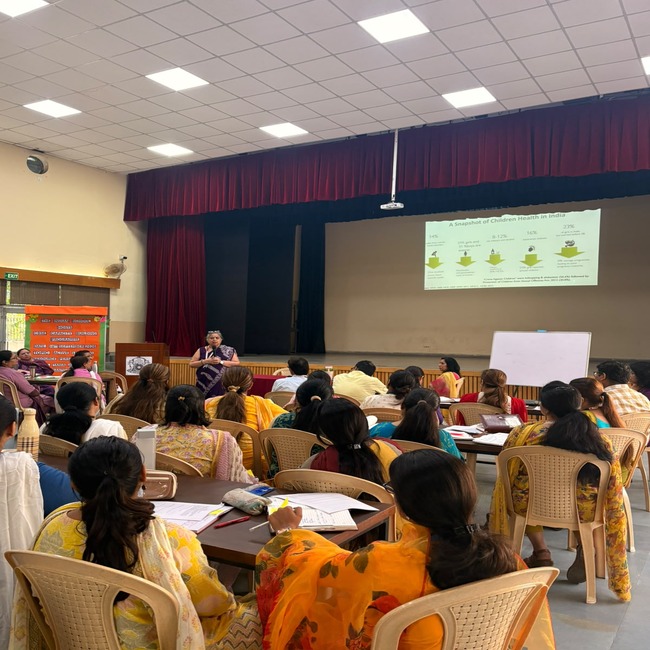
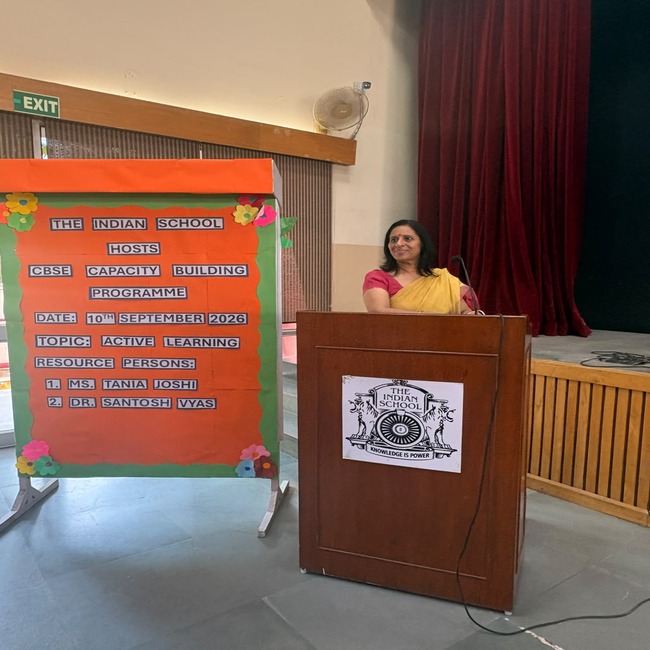
A Capacity Building Programme on Active Learning was conducted on 10 September 2026 with the objectives of equipping educators with innovative pedagogical approaches and strengthening their capacity to create engaging, collaborative, and learner-centric classrooms. The enriching programme featured two distinguished resource people, Dr Santosh Vyas and Ms Tania Joshi, Principal, The Indian School, whose expertise and insights made the session a meaningful professional learning experience.
The first session was led by Dr Santosh Vyas, an eminent educational leader and former principal of Sadhu Vaswani International School for Girls, New Delhi. Dr Vyas commenced the session with a calming breathwork exercise, encouraging the teachers to pause, centre themselves and prepare for the learning journey ahead. She then engaged the participants in a thought-provoking discussion on the VUCA world—Volatility, Uncertainty, Complexity and Ambiguity—highlighting the need to equip learners with the skills and dispositions required to navigate an increasingly dynamic world. The concept of metacognition was also explored, emphasising the importance of enabling students to reflect upon their thinking and learning processes. The session encouraged educators to move beyond conventional approaches and nurture reflective, adaptable, and independent thinkers.
The second session was conducted by Ms Tania Joshi, Principal, The Indian School. Ms Joshi's session centred on the distinction between passive and active learning, encouraging teachers to reflect on the nature and quality of student engagement in their classrooms. In an engaging opening activity, teachers were shown a book cover and invited to predict and discuss what it might be about. This simple yet powerful exercise demonstrated how curiosity, observation, inference, and discussion can transform a seemingly ordinary classroom prompt into a meaningful learning experience.
The session introduced educators to a range of effective active learning strategies, including Think-Pair-Share, Flipped Classroom, collaborative learning and inquiry-based learning. These approaches reinforced the importance of transitioning from teacher-led instruction to learning environments where students actively participate, question, collaborate, investigate, and construct knowledge.
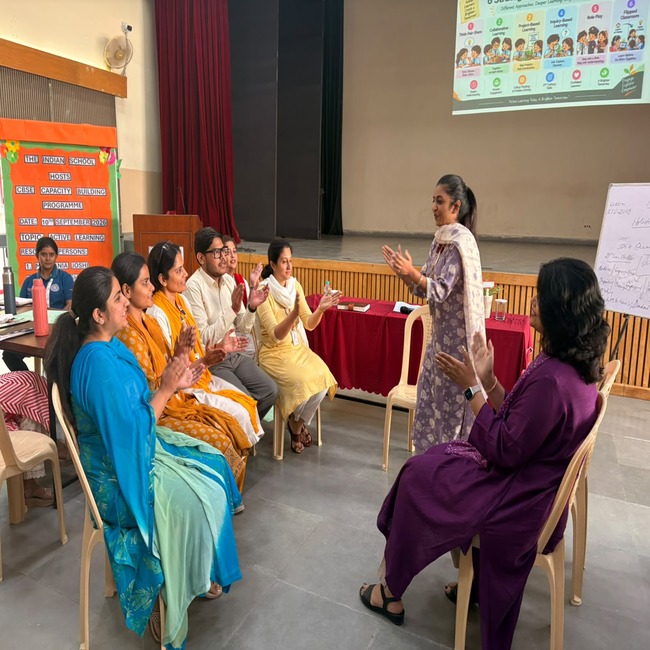
A particularly enriching segment of the programme was “Crafting the Path – Designing an Effective Active Learning Activity Plan” (ALAP). Teachers worked collaboratively to design an active learning activity based on a topic from their respective subjects. Each plan was thoughtfully structured around clearly defined learning outcomes, 21st-century skills, appropriate active learning strategies and the contextual needs of the learners. The teachers subsequently presented their activity plans, creating a vibrant platform for sharing ideas, exchanging perspectives and drawing inspiration from one another.
The programme itself served as a compelling demonstration of the very principles it sought to promote. Through reflection, collaboration, discussion, experiential tasks and presentations, the educators actively engaged in the learning process and experienced first-hand how purposeful participation can deepen understanding.
The programme concluded on an inspiring note, leaving educators with renewed enthusiasm to create classrooms that encourage curiosity, agency, collaboration and critical thinking. It reinforced the belief that when learners are given the space to think, question, explore and create, learning transcends the boundaries of the textbook and becomes a meaningful experience that stays with them.
 In the Press
 Admissions