Literary and Library Week 2026
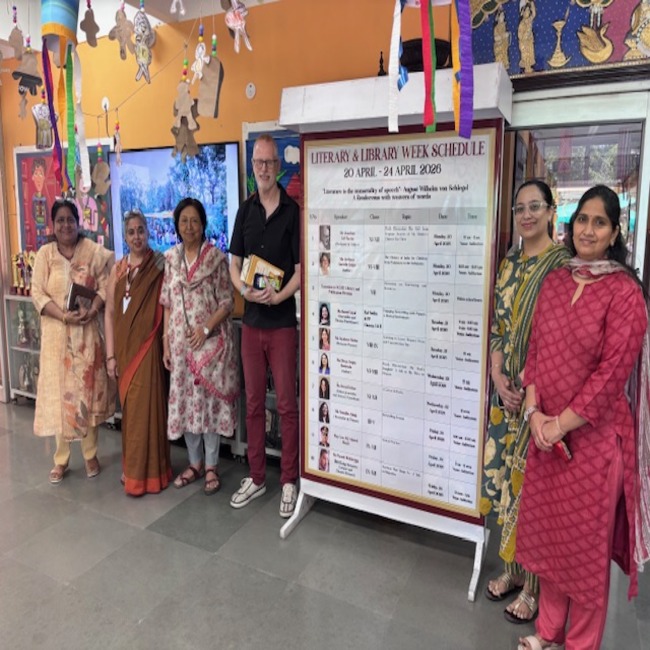
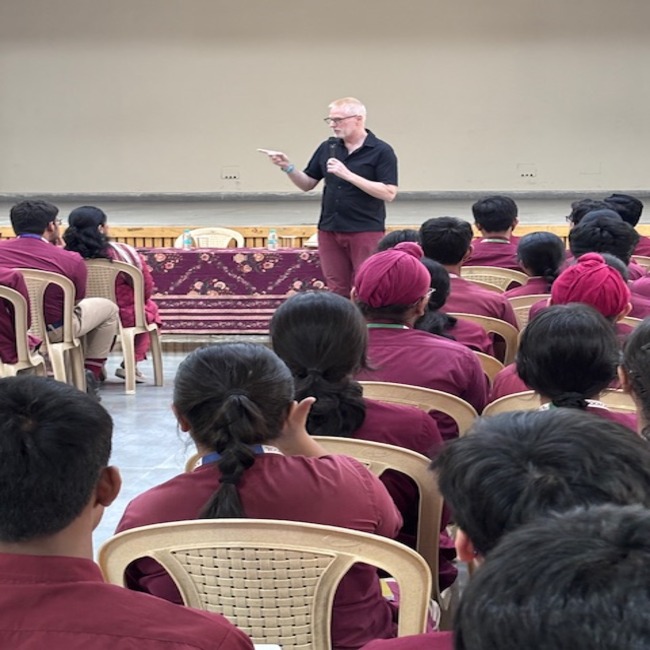
On Monday, 20 April 2026, this year’s Literary Week opened with an intellectually stimulating session led by Mr Jonathan Gil Harris, eminent professor of English, founding Dean of Academic Affairs at Ashoka University, and acclaimed author.
The occasion was graced by Dr (Mrs) Nayana Goradia, member of the School Management Committee, together with Ms Vishnupriya Rao, member of the PTA body, and Ms Tina Kapoor, Vice President of the PTA. Adding to the vibrancy was an enthusiastic gathering of over 150 students from classes XI and XII, whose presence lent the event a lively energy.
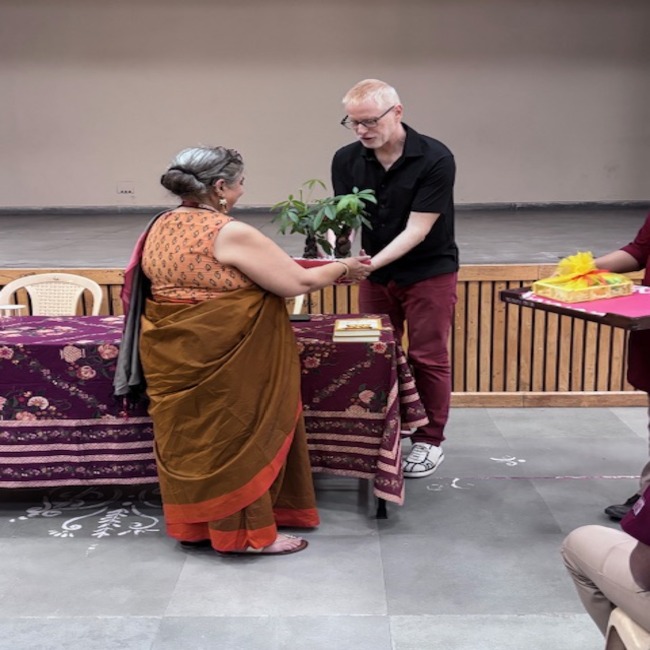
Warmly received by Principal, Ms Tania Joshi, Mr Harris was presented with a planter from the School nursery — a symbol of growth and continuity — along with a gift hamper of candles and soaps crafted by students as part of the Shramdaan project under the Citizenship Programme. The gesture reflected the School ethos of sustainability, service, and creativity, while embodying the spirit of community that the initiative seeks to nurture.
Drawing upon his celebrated work, The Girl from Fergana: Secrets of My Mother’s Chinese Tea Set, he offered profound insights into the intricate and often overlooked interconnections between migration, culture, and identity. He challenged the widespread perception of migration as a purely modern phenomenon, showing instead how centuries of movement have continually shaped languages, traditions, and social structures.
Through the narrative of his book, interwoven with poignant instances from his personal life as he grappled with his mother’s fading memory, Mr Harris offered a deeply human perspective. Quoting with quiet sorrow, “I mourned the loss of the mother who had known me in English,” he revealed how English was the first language his mother forgot as Alzheimer’s slowly eroded the city of her memory. In doing so, he demonstrated how individuals carry fragments of their heritage wherever they go, fostering cultural synthesis and enriching the societies they become part of.
He recalled his mother’s friend, Kamrakhan, whose embrace offered Stella solace during her five years in the Fergana Valley, a landscape that became both a refuge and a crucible of memory. Within its folds lay the mud hut and the market town of Uzgen, with its bustling bazaars and layered histories, where fragments of everyday life intertwined with the larger currents of migration. These recollections illuminated how places and friendships become anchors of resilience, shaping the human story amidst upheaval.
The distinguished speaker also shed light on the historical and cultural prominence of the Fergana Valley, once a thriving nexus along ancient trade routes. It was from this valley that Babur, the founder of the Mughal dynasty, set out on his journey, carrying with him memories of his homeland and the cultural imprint of Central Asia. Samarkand, with its dazzling architecture and reputation as a centre of learning, stood nearby as a beacon of the Silk Road’s grandeur. He emphasised how these links with India — through trade, migration, and cultural interaction — proved instrumental in shaping facets of Indian heritage, reminding students that the roots of cultural synthesis often lie in journeys across landscapes and centuries.
Equally captivating was his exploration of culinary migration. He explained how food ingredients and traditions travel with people, evolving across regions to create the diverse cuisines we enjoy today. Using the example of the chilli — known variously as mirch or mirchi in different parts of the world — he traced its journey from South America to India and across Asia along the Silk Roads. He recalled how his mother spoke of murch in Uzbek, weaving the spice into her memories of place and culture. By drawing parallels with Indian culture, he showed how many staple foods, though originating beyond the subcontinent, have been seamlessly woven into India’s culinary identity. He noted that the Mughal presence in India enriched this culinary tapestry further, introducing ingredients such as dried fruits, nuts, and aromatic spices like saffron, which blended with local produce to create dishes of remarkable depth and variety.
The interactive Q & A proved to be one of the most thoughtprovoking segments of the session. Students raised searching questions about the symbolism of his mother's Chinese tea chest and whether it was acceptable for parents to remain silent about their tragic pasts. Mr Harris acknowledged that such silences often stem from complex reasons: the desire not to relive trauma, the instinct to shield children from painful memories, or the difficulty of letting go while still keeping sorrow hidden. He shared that members of his own family were not in favour of his decision to make public the secret past of his mother, Stella, underscoring how personal histories can be fraught with both emotional weight and ethical dilemmas.
The session left a lasting impression, broadening students’ perspectives and encouraging them to see history not as a collection of isolated events, but as a living, interconnected process of exchange and adaptation. It stood as a compelling reminder of the deeprooted interdependence that has long defined human civilisation, and of how migration continues to shape culture, memory, and identity across generations.
 In the Press
 Admissions