Hands' on activities to learn about Magnetism In class 6
“Science becomes meaningful when students don’t just learn it—they experience it.”
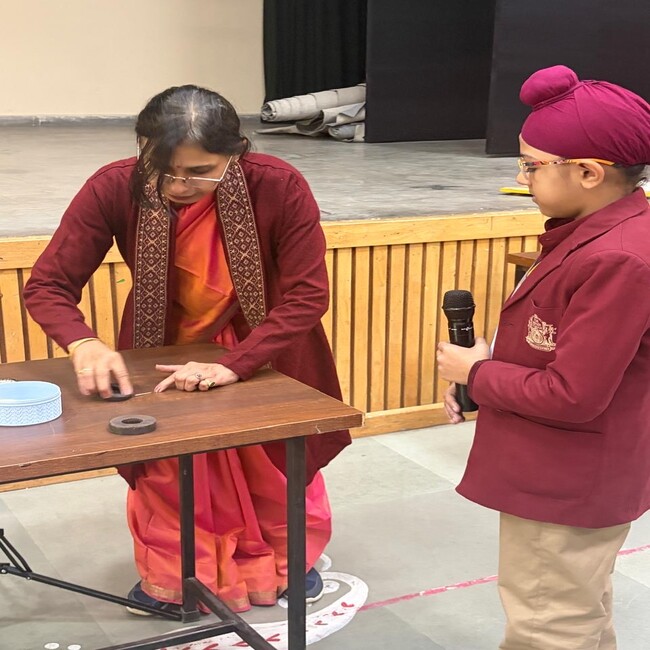
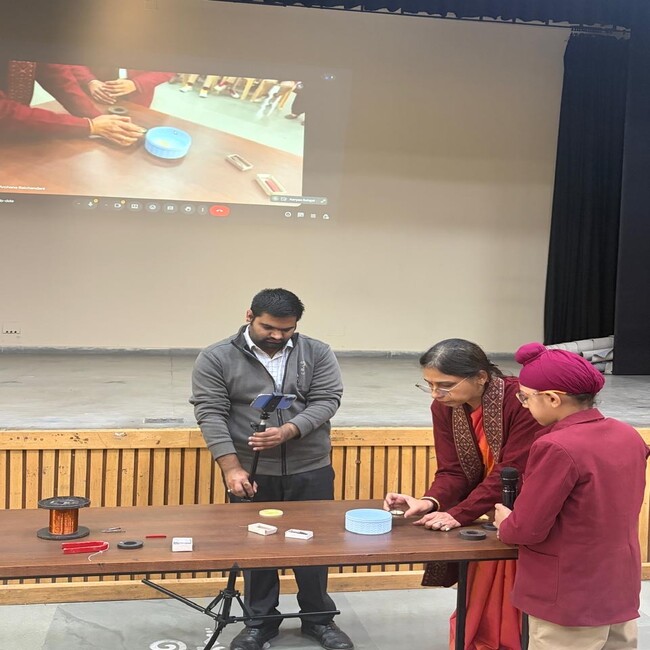
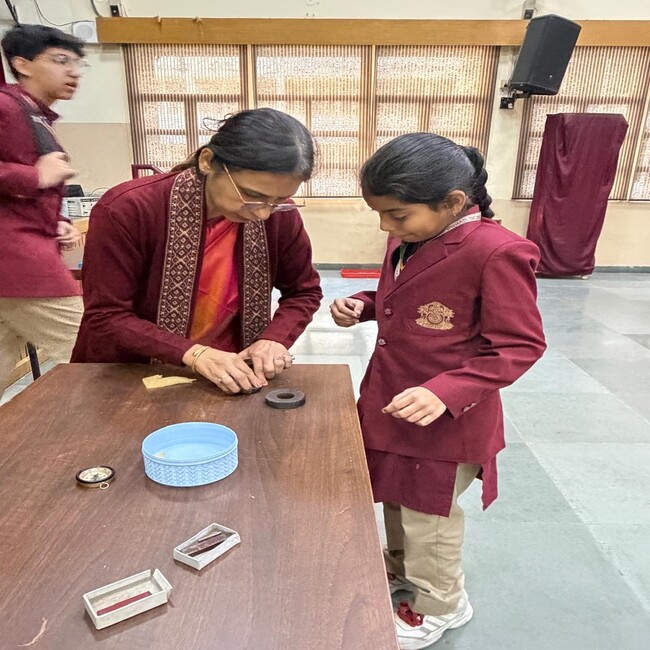
A vibrant and exciting hands'-on learning session titled “Fun with Magnets” was conducted by Ms Archana Raichandani on 16th December, 2025 for the students of class VI. The session was thoughtfully designed to spark curiosity and deepen the students’ conceptual understanding of magnetism through interactive, activity-based learning. With a strong focus on experiential learning, the students were encouraged to explore magnetic phenomena first hand and connect scientific principles with real-life applications.
The session began with an engaging activity titled Magnetic Compass Construction, where students crafted a working compass using simple everyday materials such as a needle, magnet, cork, and a bowl of water. They magnetised the needle by stroking it repeatedly with a magnet in a single direction. The needle was then inserted into a cork and made to float on water. To their amazement, the needle consistently aligned itself in the North–South direction!
This activity helped students understand key concepts such as the earth’s magnetic field and magnetic induction. The excitement in the room was evident as the learners realised how a simple experiment can mimic the working of a real compass.
Next came the fascinating Magnetic Levitation Challenge, aimed at exploring the force of magnetic repulsion. Using ring magnets and a pencil, the students stacked magnets like poles facing each other. They observed that the magnets repelled strongly and appeared to levitate in mid-air.
This striking demonstration made the “invisible force” of repulsion feel real and helped students understand the strength and behaviour of magnetic forces in a memorable way.
Adding further excitement, an additional activity introduced students to the concept of an electromagnet. A few students were invited to construct an electromagnet using an iron nail, copper wire, and a battery. They wrapped the copper wire around the nail to form a coil and connected it to the battery. The students then tested the electromagnet by checking how many paper clips it could attract.
The selected students performed the task with great enthusiasm, and their excitement encouraged the entire class to observe keenly and participate actively. This activity successfully explained electromagnetism and highlighted how temporary magnets are widely used in everyday appliances and machines.
To extend learning beyond the classroom, the students were shown a short educational video on Maglev trains in Japan. The video captivated students and helped them connect the concept of magnetic levitation with real-world advanced technology. It served as an excellent example of how scientific ideas studied in class are applied in modern innovations.
The session remained highly interactive throughout, with students enthusiastically participating in every experiment. They asked thoughtful questions, made predictions, recorded observations, and worked collaboratively—strengthening not only their scientific understanding but also essential skills such as teamwork, inquiry, critical thinking, and problem-solving.
Overall, the “Fun with Magnets” session successfully transformed the abstract concept of magnetism into an enjoyable and meaningful learning experience. It ignited a spirit of exploration and left students eager to discover more about the fascinating world of science.
 In the Press
 Admissions