Teacher workshop on Reading and Writing Skills by Oxford University Press
“When teachers learn new ways to read the learner, students learn better ways to read the world.”
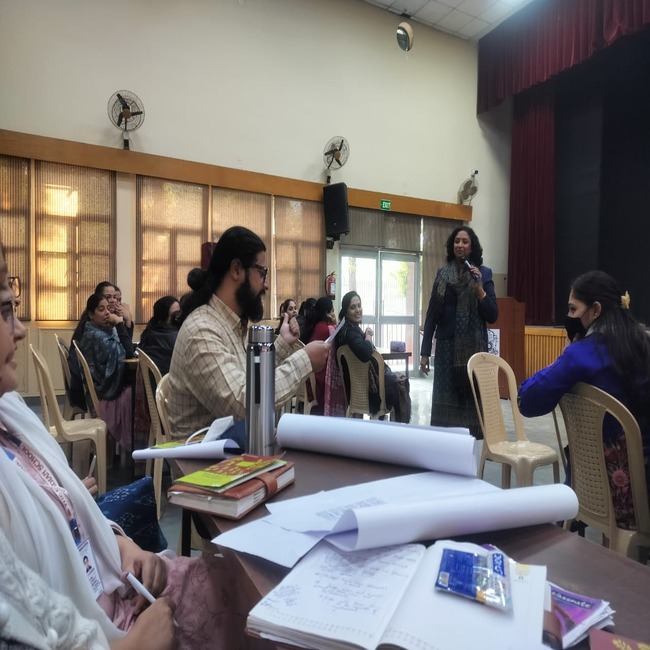
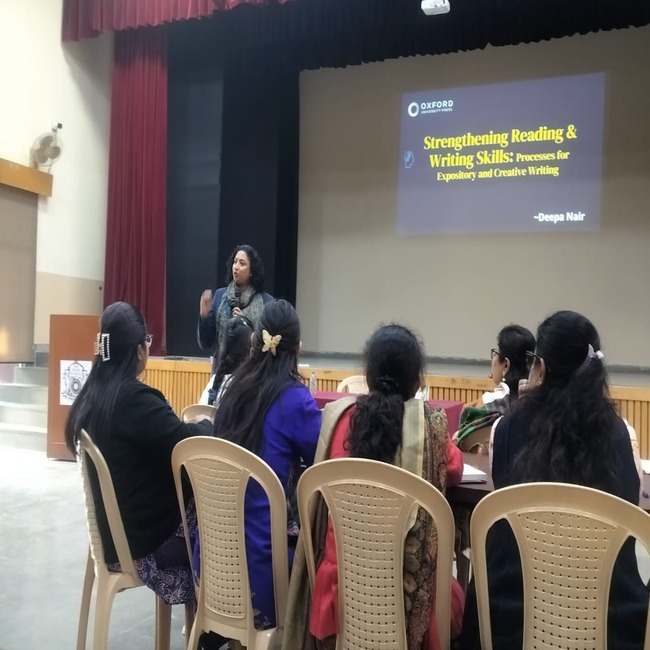
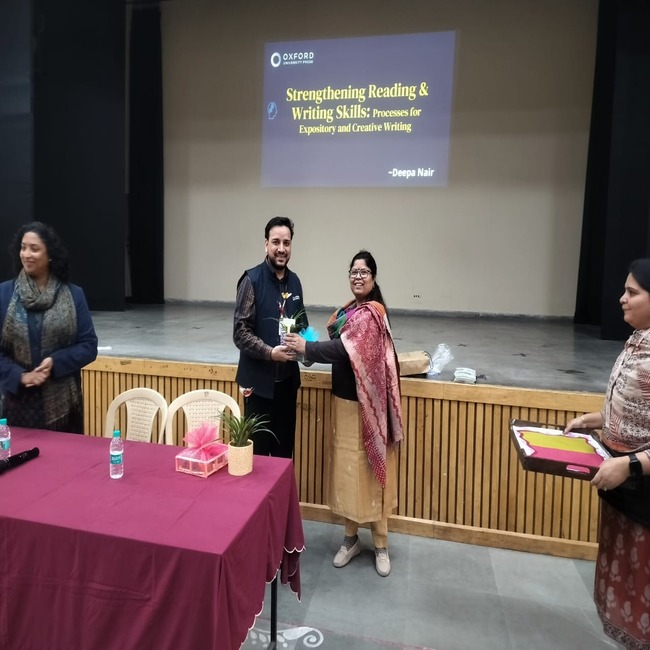
This thought set the tone for an enriching workshop conducted on 18th November, 2025 in the School auditorium by Ms Deepa Nair of Oxford University Press. The session was attended by teachers of the English and Social Science departments and focused on understanding the challenges that students face in reading and writing. It also aimed to equip the teachers with practical strategies to strengthen literacy across subjects.
The resource person began by explaining the core reasons for the difficulties that students face in regard to reading. She highlighted how confusion between similar-sounding words, inadequate knowledge of phonics, restricted vocabulary, weak reading skills and insufficient exposure to varied texts often hinder comprehension. She emphasised that recognising these gaps is essential for designing effective and meaningful learning experiences.
The workshop featured a series of interactive activities that modelled classroom practices. The teachers participated in an image-based brainstorming activity, interpreting visual prompts and sharing their insights. This exercise demonstrated how visual stimuli can promote critical thinking and spark curiosity among learners. A poem from The Beggars of Hyderabad was used to illustrate how poetic texts can be connected to real-life contexts to deepen understanding. Additionally, a picture-based descriptive writing task followed by a poem-gap activity showcased creative approaches to enhancing written expression.
A key focus of the session was the importance of linking new knowledge with students’ prior understanding to make learning more relevant and engaging. Ms Nair also explained how Bloom’s Taxonomy can guide teachers in framing questions that encourage higher-order thinking and sustained engagement. She introduced effective classroom strategies such as BDA (Before–During–After), SQ3R, KWL, and the Jigsaw technique, all of which support improved comprehension and active participation. The discussion on the mechanics of writing further helped teachers understand how to guide students in producing clearer, more coherent written work.
Overall, the workshop was insightful, practical, and thoughtfully delivered. It provided teachers from both English and Social Science departments with valuable tools to strengthen reading and writing skills and reaffirmed the importance of nurturing confident readers and expressive writers across all subjects.
 In the Press
 Admissions