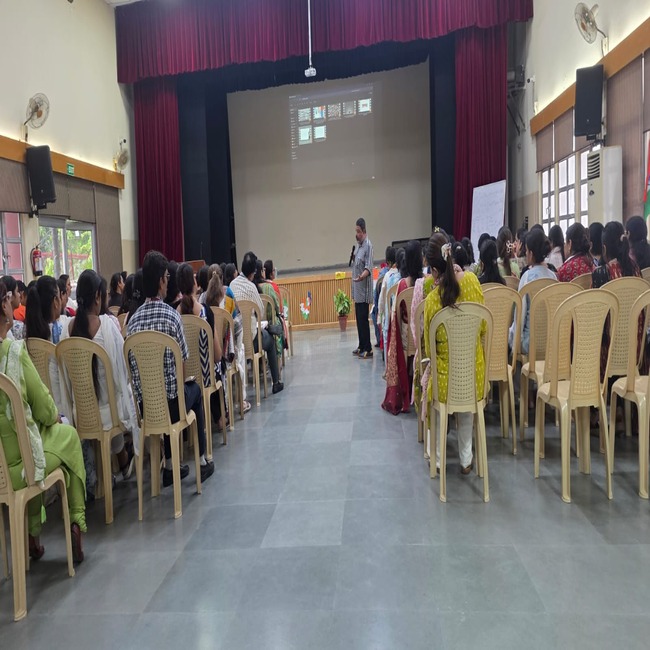
Teacher workshop on the integration of real world happenings with the curriculum
A teacher enrichment session on “Integration of Contemporary Happenings in Classroom Teaching and Lesson Planning” was conducted on 14 August 2026 in the School Auditorium. The session was led by Mr Parnab Mukherjee, who engaged the teachers in an interactive and thought-provoking discussion on making classroom teaching more dynamic, relevant and connected to the real world and beyond the textbook.
The session focused on the importance of moving away from purely content-driven instruction towards a more participatory, interdisciplinary and contemporary approach to learning. Through practical examples, strategies and audio-visual resources, Mr Mukherjee demonstrated how everyday happenings and current issues can be seamlessly woven into lessons to encourage curiosity, critical thinking, discussion and meaningful participation among students.
The session began with an interesting exercise. Mr Mukherjee asked the teachers to identify five to six “fast-track” students in their classes. He clarified that these students need not necessarily be the class toppers or high achievers. Rather, they could be students who are quick to grasp ideas, curious, responsive, observant, articulate or capable of making connections independently.
This led to an important reflection on the need to recognise different kinds of learners in a classroom and to create opportunities for students who may demonstrate potential beyond conventional academic achievement.
Mr Mukherjee introduced the concept of Participating Pedagogy, emphasising that students should not remain passive recipients of information. Instead, they should become active participants in the learning process.
He encouraged teachers to design lessons in which students observe, question, discuss, investigate, interpret and contribute, rather than merely listen and reproduce information. Contemporary events can serve as effective triggers for such participation because they provide students with contexts that are familiar, immediate and open to multiple perspectives.
Key Tools
1. Lesson Tree
One of the key tools introduced during the session was the Lesson Tree. Mr Mukherjee suggested that teachers should avoid viewing a lesson as a linear sequence of concepts. Instead, a central concept can be placed at the centre and explored through multiple branches or “directions”, allowing for multidisciplinary and lateral connections.
He illustrated this with the concept of “HEAT.”
- D1 – Physics: The scientific understanding of heat, temperature and thermal energy could be explored.
- D2 – English/Languages: Teachers could examine how the word “heat” is used in language and literature. For instance, expressions such as “in the heat of the moment,” “heated argument”
- D3 – Geography/Environment: The discussion could move towards rising temperatures, heat waves, climate change and their geographical and environmental implications.
- D4 – Contemporary Affairs: Students could be asked to search newspapers and identify how the word “heat” has recently been used in the news, perhaps in reports about heat waves, record temperatures, elections, sporting events or diplomatic tensions.
Thus, a single concept can become the trunk of a lesson tree, with different disciplines and contemporary contexts forming its branches.
The strategy demonstrated how teachers can move from textbook knowledge to contextualised learning, encouraging students to see connections between subjects rather than viewing them as isolated areas of study.
2. Transient Root Method
Another strategy discussed was the Transient Root Method. Mr Mukherjee suggested that teachers could break a lesson into approximately 12 significant keywords or conceptual roots.
He illustrated the technique through Shakespeare’s Hamlet. Instead of approaching the play only as a literary text, teachers can identify its key conceptual roots and use these as starting points for discussion, exploration and contextual connections.
This approach can help students move from keywords to concepts, concepts to questions and questions to wider contemporary connections. It also encourages learners to see a lesson as a network of ideas rather than a fixed body of information to be memorised.
3. Component Learning
The third strategy introduced was Component Learning, in which an ordinary object or concept is examined by breaking it down into its various components.
Mr Mukherjee illustrated this with the example of a “dupatta”. A seemingly simple everyday object can become a rich interdisciplinary learning resource. Students can examine:
- the material or fabric used
- its texture and properties
- its design and patterns
- dyes and colours
- traditional methods of production
- block printing or machine production
- the geographical origins of different textile traditions
- artisans and the economics of handicrafts
- sustainability and the environmental impact of textile production
The example demonstrated that learning opportunities exist in everyday objects, provided teachers encourage students to look beyond their immediate function and investigate the different dimensions associated with them.
4. Podium Management
Mr Mukherjee also introduced the concept of Podium Management, emphasising the importance of creating structured opportunities for students to speak in the classroom. He suggested that teachers use a podium to encourage students to come forward and speak. Such a practice can help develop confidence, articulation, public-speaking skills and the ability to communicate ideas before an audience. The emphasis was not merely on formal speeches but on creating a classroom environment in which students regularly express opinions, respond to questions and articulate their understanding.
The session also incorporated audio-visual resources. Mr Mukherjee screened two videos, “Bottled Water” and “In Our Hands”, and used them to demonstrate how a short visual stimulus can become the starting point for classroom discussion and inquiry.
Such resources can help teachers introduce contemporary issues in an accessible manner and encourage students to move beyond simply viewing content to questioning, analysing and forming informed opinions.
A significant takeaway from the session was that current affairs need not be treated as a separate or additional component of the curriculum. Instead, contemporary happenings can be integrated organically into existing lessons. A literary text, scientific concept, mathematical principle, historical event or geographical phenomenon can be connected to something students encounter in the news or in their everyday environment.
The session encouraged teachers to rethink the traditional boundaries of a lesson and explore ways of making classroom learning more participatory, interdisciplinary and connected to real life.
 In the Press
 Admissions